Local Solana runtime
A local Solana runtime with real guard rails.
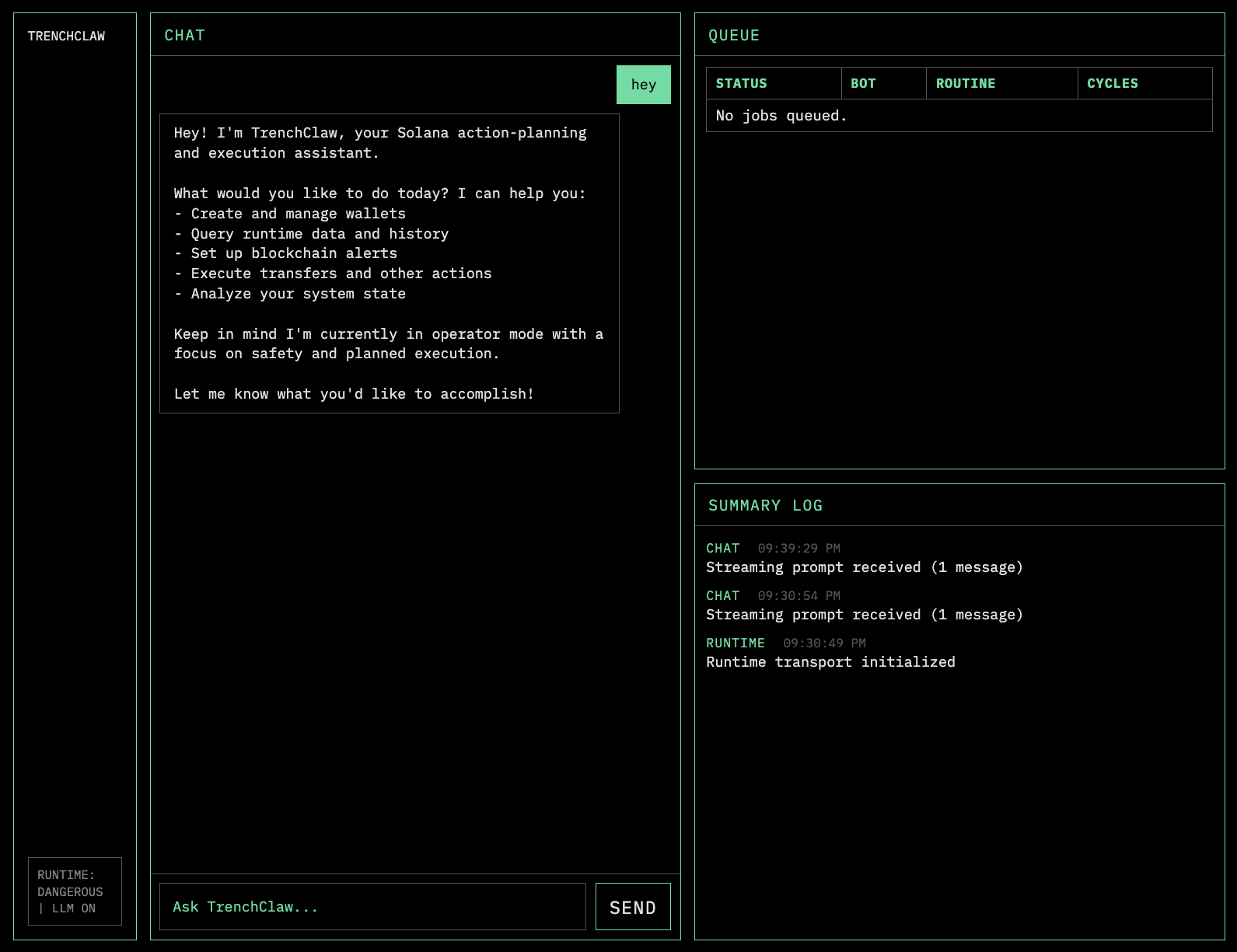
TrenchClaw is a Bun + TypeScript runtime for Solana operator workflows with validated actions, managed wallets, local state, and a GUI that talks to the runtime instead of replacing it.
The important difference from thinner OpenClaw-style wrappers is the execution model: tool-gated execution, settings-aware policy checks, instance-scoped state under `.runtime-state`, and a repo-tracked `.runtime` contract that is not treated as live mutable state.
$ trenchclaw
booting runtime...
readonly app loaded from ~/.local/share/trenchclaw/current
state root: ~/.trenchclaw
scheduler online
web gui: http://127.0.0.1:4173
docs: /docs/getting-started
ready for actions and routines
macOS
copy + runcurl --proto '=https' --tlsv1.2 -sSfL https://trenchclaw.vercel.app/install/macos-bootstrap.sh | bashLinux
copy + runcurl --proto '=https' --tlsv1.2 -sSfL https://trenchclaw.vercel.app/install/linux-bootstrap.sh | bashFetches the installer, which resolves a GitHub Release tarball and verifies its checksum before install.
Start here
The three pages that explain the product.
Start with setup, move to keys only when you need to change providers, and use architecture when you want the runtime model instead of the onboarding path.
Guide
Getting Started
Install TrenchClaw, launch the runtime, sign into an instance, add one AI key, and get to a clean first chat.
Guide
Keys and Settings
Which keys matter, which settings matter, and how to keep the default TrenchClaw setup clean.
Reference
Architecture
How TrenchClaw actually ships: runtime authority, tool snapshots, lane routing, instance state, and execution boundaries.
Guard rails
Why TrenchClaw is not just a wrapper.
The runtime decides what exists, what is enabled, and where state is allowed to live. That makes the operator surface narrower, more inspectable, and easier to reason about than broad shell-first agent setups.
Tool-gated execution
The model only gets the action and workspace tools that are present in the runtime tool snapshot for the current run.
Policy checks before side effects
Unsupported or disabled actions are blocked before execution, and dangerous actions can require explicit user confirmation.
Instance-scoped state
Vaults, wallets, settings, logs, caches, and workspace files live under one active instance instead of a loose shared folder.
Runtime-owned source of truth
The GUI is a client for runtime APIs. The canonical state lives in the runtime layer and on disk, not in frontend-only state.
Stack
What actually ships.
Runtime state model
The folders that matter.
| Boundary | What it is | Why it matters |
|---|---|---|
| .runtime | Repo-tracked runtime contract and template area | Not the live mutable state root |
| .runtime-state | Per-instance mutable state for settings, vaults, wallets, logs, and SQLite | This is the source of truth at runtime |
| Workspace | Instance-scoped operator files, notes, configs, routines, and output | Keeps automation and manual work attached to one instance |
Local GUI
The GUI sits on top of the runtime.
The frontend is there to inspect and operate the runtime cleanly. The runtime remains the storage and execution authority underneath it.